




Carmelite Monastery
of St. Therese
The cradle of the Carmelite Order can be found in the Wadi ‘ain es-Siah on Mount Carmel, near the modern city of Haifa, Israel, where the ruins of the Chapel and dwelling places can still be found. There, in the 11th Century a group of hermits came together to live in the spirit of the Prophet Elijah, the great witness of God’s living presence. Around 1205, they approached Albert, the Patriarch of Jerusalem to give them a Rule (Formula of Life). Familiar with their way of life, he wrote a short Rule in the form of a letter. It is simple, flexible and deeply rooted in Scripture. It is still the foundational text for Carmelites today, adapting to different times and circumstances
Carmelites through the Centuries
The most beautiful and profound emotion we can experience is the sensation of the mystical.
What is vocation
The path which consecrated life is called to follow, at the beginning of the new millennium, is guided by the contemplation of Christ…
Lectio Divina
When you seek truth, you seek God whether you know it or not. (Edith Stein)
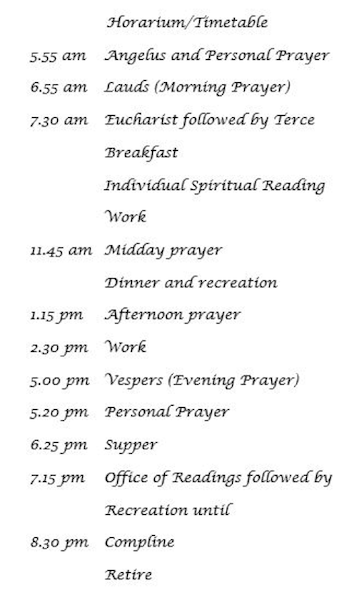
Horarium/Timetable
Trust in God at all times, you people; Pour out your hearts to the Lord, for God is our refuge. (Psalm 62:8)
Silence and solitude
Chapter six of the Carmelite Rule asks us to work in silence. Carmelite Kees Waaijman explains that silence is far more than the absence of audible noise: Silence is not just about time or place but about the character of work and communication. To work in silence is to turn off the applause machine. It is to trust in the horizon of the future, beyond one's own time - and indicate that horizon to others. It is to work with intentionality without needing evident, creditable results. We work in the present, not for the present. When we do this, creativity is transformed into hope -- specifically hope for those who are hopeless, shattered by their own present experience with no way out. To be a prophet is not to predict the future but to be a messenger of the future to which God calls us, a messenger of truth, hope and justice. A prophet calls God's people to a transformation that will allow conscious life to evolve towards God's future. Silence is essential to this prophetic witness.
The creative balancing of solitude and community is part of the history of monasticism, and the history of our order. Silence and solitude are critical in making a place to find God. In solitude we learn to surrender to the work of God, to know God's presence in a deep and intimate way, and to rest in that presence. In touching God's presence, we also discover our deep solidarity with all our brothers and sisters around the world. In times of solitude a person is brought by God to deep self-knowledge, a necessary part of the life of prayer. Only by knowing ourselves can we bring the person we authentically are to the encounter with God? Times of solitude also challenge us to allow the ego to be stripped of all that is false, and to empty the self. When a person lacks any source of external affirmation, as she does in solitude, she comes to know the truth of her being and what she is living for. We take one "hermit day" a month when we enter into deeper silence. These days are spent with greater focus on prayer and spiritual reading. At other times we maintain a quiet atmosphere in the house and work silently when this is possible.
Lectio Divina
Lectio Divina
Lectio Divina, an ancient monastic tradition, is a simple way of praying the scripture by taking the word of God deeper and deeper into oneself, and thereby seeking a growing friendship and communion with Christ in God. While Lectio Divina can be valuable in the development of personal contemplative prayer, it is also a treasured, time-proven process for communal prayer and commitment. Our community gathers from time to time for Lectio Divina in common. In contemporary spirituality various adaptations are made of the four essential stages or stations in this practice. Lectio: reading a scripture text slowly and out loud if possible, opening oneself to the power of God's presence and guidance in the word and allowing oneself to be attracted and attentive to the particular word, phrase, or sentences that resonate with special vibrancy within one.
What is vocation
“The path which consecrated life is called to follow, at the beginning of the new millennium, is guided by the contemplation of Christ…a gaze fixed, more than ever, on the face of the Lord.” (Starting Afresh with Christ, 2002)
What is vocation
A vocation is a call to that special way of life ordained for one by God, part of a great divine plan. It is a mystery of God’s grace. God Who loves us, who is love, is also “He Who calls”. God always takes the initiative, as in the story of Jesus and the Samaritan woman (John 4). Jesus asks her for a drink and she in turn offers her living water. She responds by bringing many others to Jesus. That invitation is extended to everybody.
- If Yes? How do you know? Do you feel that God is calling you to follow Him more closely? Do you like to pray? Do you feel drawn to life in community? What do you do? Pray and reflect about the calling, ask the help of a trusted guide, find out more about religious life or contact the community at Benoni, please refer to our contact us page for contact details.
Signs of a Carmelite Vocation
Here are some signs of a Carmelite vocation:
- A belief in the power of prayer: Saint Teresa of Avila understood prayer as an apostolic work for the sake of the Church and God's people. We believe that prayer can open our world to the transformation that God seeks to work in souls.
- What kind of work for God’s people most attracts you? If the work of prayer is predominant, you may have a Carmelite vocation.
- Drawn to significant periods of silence and solitude: Intimacy with God is nurtured in times of silence and solitude. If you find yourself regularly seeking times to be alone with God, you may have a Carmelite vocation.
- Desire to live in the same community for life: If you are drawn to live in simplicity, in companionship with other sisters whom God has called to community, you may have a Carmelite vocation.
Attracted to Carmelite spirituality: Carmelites have a rich spirituality articulated in the writings of great men and women who understood the life of prayer and the path to union with God. Teresa of Avila, John of the Cross, Edith Stein, Therese of Lisieux, and other Carmelites served God's people by being united with Christ in the depths of their soul, contemplatively present to those in need. If you are attracted by their teachings and seek to serve God and God’s people as they did, you may have a Carmelite vocation.
About

A brief history
The cradle of the Carmelite Order can be found in the Wadi ‘ain es-Siah on Mount Carmel, near the modern city of Haifa, Israel, where the ruins of the Chapel and dwelling places can still be found. There, in the 11th Century a group of hermits came together to live in the spirit of the Prophet Elijah, the great witness of God’s living presence. Around 1205, they approached Albert, the Patriarch of Jerusalem to give them a Rule (Formula of Life). Familiar with their way of life, he wrote a short Rule in the form of a letter. It is simple, flexible and deeply rooted in Scripture. It is still the foundational text for Carmelites today, adapting to different times and circumstances. The Rule in summary is as follows:
- To live in allegiance to Christ by serving him faithfully with a pure heart and an upright conscience, by placing our sole hope of salvation in him, and by paying him obedience, in the person of the Prior, in a spirit of faith;
- To remain in one’s cell, meditating day and night on the law of the Lord, and fortifying the spirit with holy thoughts, so that the word of God may abound on our lips and in our hearts, and everything be done in the word of the Lord.
- To celebrate every day in community the Eucharist and the Prayer of the Church.
- To practice evangelical asceticism and to be clothed with the divine armour in order to live devotedly in Christ; to imitate the Apostle Paul in generous application to work; and to practice constant mortification with prudence which is the guide of the virtues.
- To establish a communion of life that is sustained by familial relations, by the charity of mutual correction, by the common possession of goods and by mutual spiritual solicitude under the guidance of the Prior who is placed at the head of the community to serve it;
- Above all, to promote unceasing prayer in solitude, silence, and in a spirit of evangelical vigilance.
The Carmelites did not remain long on Mount Carmel due to political unrest and persecution. Some of the early Carmelites were killed and the others migrated back to Europe. In the 15th Century the Carmelite General began the first monasteries of nuns. These evolved from groups of pious women (Mantallatas or Beguines). These women now imbibed the spirit of Carmel, living lives of prayer in various European towns and cities.
Teresa de Ahumada de Cepeda was born in Spain in 1515 and entered the Carmelite Monastery of the Incarnation in Avila about 50 years after its foundation. The community was however overcrowded and struggling to maintain itself, forcing the nuns out of enclosure to go begging. In this situation Teresa rediscovered the Primitive Rule of St Albert and embarked on a reform and refounding of the Order going back to the essentials. All this happened after the Protestant Reformation. Teresa saw the need for Church reform – she began by reforming herself.
After her death in 1581, the nuns spread her charism from Spain to France and the Lowlands (Belgium and Holland). English Catholic women persecuted in their own country founded Carmels in Antwerp, Lierre and Hoogstraet. They returned to England after the upheavals of the French Revolution. The Carmel of Lierre settled in Darlington and it was from that community in 1931 that six sisters set sail for South Africa and founded the Carmel of Rivonia near Johannesburg and remained there for 60 years. The community moved to the East Rand in the early 1990s and finally built a new monastery in Benoni in 1995/6.
Here we still breathe the spirit of Carmel, living a life of allegiance to Christ, earning our living by the work of our hands, living as sisters sharing a common vision, witnessing, as the Prophet Elijah did, to the fact that God lives in whose presence we stand (cf. 1 Kings)
Carmelites through the Centuries
The most beautiful and profound emotion we can experience is the sensation of the mystical. It is the sower of all true science. He or (she) to whom this emotion is a stranger, Who can no longer wonder and stand rapt in awe, is as good as dead. (Albert Einstein)
“The Little Arab” Mariam Baourdy Mariam Baourdy, “The Little Arab” was canonized in Rome by Pope Francis on Sunday, 17th May, 2015. May she intercede for peace in the Holy Land and throughout the whole world.
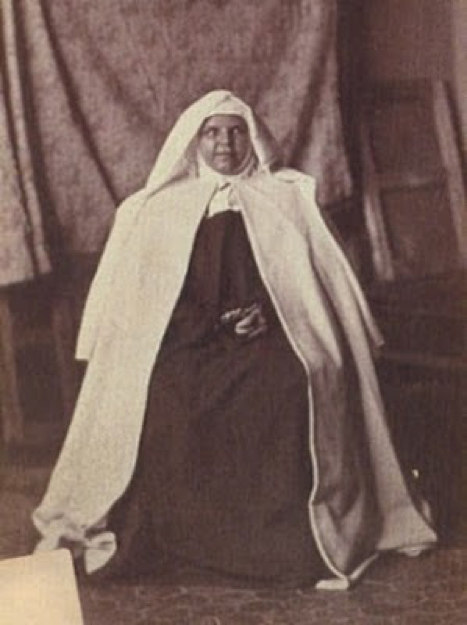
"I am in God, and God is in me. I feel that all creatures, the trees, the flowers belong to God and also to me. I no longer have a will, it belongs to God. And all that is God´s is mine. Mariam, Sr Mary of Jesus Crucified

A brief history
How fitting it is that during this time between Ascension and Pentecost, Blessed Mary of Jesus Crucified (Mariam Baourdy), a humble daughter of the Holy Land should be proclaimed a Saint by Pope Francis. Mariam had such a great devotion to the Holy Spirit, with her let us pray:
- Holy Spirit, inspire me. Love of God, consume me. Along the true road, lead me. Mary my Mother, look upon me. With Jesus, bless me. From all evil, from all illusion, from all danger, preserve me.
- Source of peace, Light, come and enlighten me. I am hungry, come and nourish me. I am thirsty, come and quench my thirst. I am blind, come and give me light. I am poor, come and enrich me.
"Pay attention to little things. Everything is great before the Lord. The Lord does not want robbery in the sacrifice. Offer and give Him everything. Mariam, Sr Mary of Jesus Crucified
Concerning devotion to the Holy Spirit she wrote: "The world and religious communities are seeking novelties in devotions, and they are neglecting true devotion to the Paraclete. That is why there is error and disunion, and why there is no peace or light. They do not invoke light as it should be invoked, and it is this light that gives knowledge of truth. It is neglected even in seminaries . . . . Every person in the world that will invoke the Holy Spirit and have devotion to Him will not die in error." “The humble heart is the chalice holding God.” – Bl. Mariam Mariam, the Little Arab, was born to a poor Greek Melchite Catholic couple, Giries Baouardy and Mariam Shahine, Twelve of her thirteen brothers died in infancy, her parents went to Bethlehem to pray to Our Lady for a child, and Mariam's birth was an answer to their prayer. Her parents died when she was only two, and she was raised by a paternal uncle. She moved to Alexandria, Egypt when she was eight years old. When she was 13, her uncle arranged a marriage for her. She refused, insisting that she wanted religious life. Her uncle punished her by, hiring her out as a domestic servant, giving her the most menial work. A Muslim servant befriended her, hoping to convert her from Christianity. On 7 September 1858, when Mariam refused to abandon her faith, he slit her throat and left her for dead in an alley. Mariam survived. A lady dressed in blue came and stitched her wound, Mariam felt it was the Virgin Mary. The 10cm scar on her neck remained as a reminder of her ordeal. She left her uncle's house forever. Mariam worked as a domestic for a Christian family. In 1860 she tried her vocation with the Sisters of Saint Joseph, but supernatural phenomena began to occur around her, and the Sisters would not let her join their community. In 1867 entered the Carmel at Pau, in the Pyrenees, France and became a lay sister. She took the name Mary of Jesus Crucified, and made her final profession on 21 November 1871. She continued to experience supernatural phenomena. She fought off a demonic possession for 40 days, received the stigmata, and was seen to levitate. She had the gift of prophecy but above all a truly humble and obedient spirit. She went to India to help found the Carmel of Mangalore. She returned to France in 1872. She spent the last threeyears of her life back in the land of her birth, where together with six other sisters she founded the Carmelite monastery in Bethlehem in 1875. In 1878 plans were being madefor the foundation of the Carmel in Nazareth and Sr Mary of Jesus Crucified went to fix the place of the future Carmel. It would however only be founded after her death. She died on 26th August, 1878. Pope St Pius X signed the decree for the introduction of her Cause and on 13 November 1983 Pope St John Paul II proclaimed her blessed. From the Homily of Pope Francis during the canonization Mass of Mariam the Little Arab and three other 19th Century religious sisters. An essential aspect of witness to the risen Lord is unity among ourselves, his disciples, in the image of his own unity with the Father. Today too, in the Gospel, we heard Jesus’ prayer on the eve of his passion: “that they may be one, even as we are one” (Jn 17:11). From this eternal love between the Father and the Son, poured into our hearts through the Holy Spirit (cf. Rom 5:5), our mission and our fraternal communion draw strength; this love is the ever-flowing source of our joy in following the Lord along the path of his poverty, his virginity and his obedience; and this same love calls us to cultivate contemplative prayer. Sister Mariam Baouardy experienced this in an outstanding way. Poor and uneducated, she was able to counsel others and provide theological explanations with extreme clarity, the fruit of her constant converse with the Holy Spirit. Her docility to the Spirit also made her a means of encounter and fellowship with the Muslim world.
Horarium/Timetable
Liturgy of the Hours
The Liturgy of the Hours/Divine Office is the universal prayer of the Church and an ancient monastic tradition that infuses the hours of the day with prayer. This prayer uses the psalms and scripture for its basic form and structure. The liturgy of the hours is fundamental for contemplative communities, but it is also prayed, communally or in private, by religious, priests and lay people from all walks of life. In Benoni Carmel, Lauds is prayed before the celebration of the Eucharist. A number of people join us for Morning Prayer and Mass. We chant vespers each day. Vespers includes a time of intercessory prayer for the needs of the world, the intentions of those who have asked for prayer, and the concerns we carry in our own hearts for others. In the evening we come together for the Office of Readings and the day ends with Compline which is sung accompanied by the Zither.
What is Vocation
A brief history
The cradle of the Carmelite Order can be found in the Wadi ‘ain es-Siah on Mount Carmel, near the modern city of Haifa, Israel, where the ruins of the Chapel and dwelling places can still be found. There, in the 11th Century a group of hermits came together to live in the spirit of the Prophet Elijah, the great witness of God’s living presence. Around 1205, they approached Albert, the Patriarch of Jerusalem to give them a Rule (Formula of Life). Familiar with their way of life, he wrote a short Rule in the form of a letter. It is simple, flexible and deeply rooted in Scripture. It is still the foundational text for Carmelites today, adapting to different times and circumstances. The Rule in summary is as follows:
- To live in allegiance to Christ by serving him faithfully with a pure heart and an upright conscience, by placing our sole hope of salvation in him, and by paying him obedience, in the person of the Prior, in a spirit of faith;
- To remain in one’s cell, meditating day and night on the law of the Lord, and fortifying the spirit with holy thoughts, so that the word of God may abound on our lips and in our hearts, and everything be done in the word of the Lord.
- To celebrate every day in community the Eucharist and the Prayer of the Church.
Here we still breathe the spirit of Carmel, living a life of allegiance to Christ, earning our living by the work of our hands, living as sisters sharing a common vision, witnessing, as the Prophet Elijah did, to the fact that God lives in whose presence we stand (cf. 1 Kings)